Tag Archives: advantage play

Online Casinos Face a New Threat: AI-Powered Card Counting

By Stefan Almgren.

Ask a decent AI model to keep a Hi-Lo count and it will do it flawlessly, card after card, for as long as you keep feeding it. It doesn’t get tired, and it doesn’t fudge the true count because the division got annoying. So whether AI can count cards isn’t really a question anymore. It can. The more interesting question is what that means for online blackjack, and I think the answer is a real headache for casinos.

AI Powered Blackjack

Some context on where I’m coming from. I learned to count years ago, and these days most of my blackjack is played at live dealer tables. The system most people use is Hi-Lo: 2 through 6 count +1, 7 through 9 count zero, tens and aces count -1. You keep a running total, divide it by the decks left to get the true count, and bet more when it climbs, because a shoe heavy in tens and aces pays more blackjacks and busts the dealer more often. It’s been a known way to beat the game since Edward Thorp published Beat the Dealer in 1962.

The part people skip is what sits underneath the count. The edge a count gives you is thin, around 1% even when things go your way, so it only works if every hand is already played perfectly for the table’s exact rules. For getting that right, I’d point anyone to the blackjack section at Beat the Fish. Alongside a run of strategy guides, they’ve built a proper toolkit: a strategy calculator that solves the right play for your table’s exact rules, a basic strategy trainer that deals you hands and grades every decision, a house edge calculator that shows what a table’s rules cost you, and an insurance checker that factors in the cards you’ve already seen leave the shoe. A dedicated card counting trainer is on the way too.

What AI does better than any human counter

Counting is simple arithmetic. What makes it hard for people is doing it fast, silently, for hours, while looking like you’re not doing it. None of that is hard for software.

A program keeps a perfect running count and works out the exact true count from the exact number of cards left, not from eyeballing a discard tray. It can track every card rather than just the Hi-Lo tags, so it always knows how many aces or fives are still in the shoe. A human counter memorizes a couple of dozen strategy changes for high and low counts. Software can simply solve each decision for what’s actually left.

Online, it doesn’t even need a camera pointed at the table. Studios read every card electronically so the game can show it on your screen, usually with the hand total next to it. GLI-19, the testing standard many regulators use, actually bars live casino platforms from giving players a real-time tracker of cards played or remaining, so the game won’t keep the count for you. But every card still crosses your screen, and software can keep its own.

I tried the low-tech version myself: typed out the cards from a few live shoes and asked a chatbot for the running and true count at random points. It was right every time I checked, and a lot quicker than me. It has already gone past chatbots, too. Paid tools that claim to read the cards straight off your screen and give you the count and the right play at the big live casinos are being advertised online right now.

The real problem is scale

Most live dealer tables deal from an eight-deck shoe and reshuffle somewhere around halfway, which is why counting live dealer has always looked pointless. I ran it through a simulation (eight decks, cut at 50%, Hi-Lo, a few million rounds). Only around one round in 15 starts at a true count of +2 or better. At a single table that’s three or four good hands an hour. Not worth the effort for a person.

On those hands, though, the player has roughly a 0.9% edge. That’s the house edge turned around.

Now picture a program watching 20 tables at once and only betting when a shoe turns good. Counters call this back-counting, or wonging, after Stanford Wong. At about 50 rounds an hour per table, that program finds roughly 65 good hands an hour. Flat betting $100 on each is worth around $58 an hour in expected profit. It’s not a money printer, and the swings are big (after 100 hours it would still be behind about a quarter of the time), but the direction has flipped. The casino is the one slowly losing, and the software never gets tired or sloppy.

Online live blackjack is close to built for this. At Evolution’s standard tables, a virtually unlimited number of players can bet behind the seven seated ones, and games like Infinite Blackjack or Pragmatic Play’s ONE Blackjack have no seat limit at all. Nobody needs a seat to get a bet down when the count is right. A back-counter in Vegas gets spotted hovering behind a table. A script doesn’t hover anywhere.

How casinos are fighting back

Casinos aren’t blind to this, and most of their defenses already exist.

The simplest is the shoe. Cutting shallower, shuffling more often or moving to continuous shuffling machines kills the count at the source, and you can’t always tell from the stream when a table uses one.

Then there’s the data. Every bet is recorded, and an account that sits out until the count climbs and then bets big leaves a very obvious trail. GLI-19 also requires operators to have procedures for detecting bots and unauthorized software, and it mentions card tracking by name. Casino terms back that up. Most ban bots and outside assistance software, some name artificial intelligence outright, and one set I read reserves the right to check which programs are running on your computer. Get caught and you’re looking at a closed account and voided winnings.

Land casinos have fought this battle before. Nevada makes it a felony to use any device or software that tracks cards at a casino game, and its Gaming Control Board urged casinos to ban Google Glass from the gaming floor back in 2013. With a new wave of camera glasses on the market, surveillance experts are now warning that card-recognition glasses can keep the count for whoever’s wearing them.

And casinos have AI of their own. Back in 2010, a California casino was already running a camera system called TableEye21 that rated each player’s skill and flagged counters. The newer generation goes further. Angel, one of the biggest names in table game technology, has been showing blackjack tables with cameras that read the bets, the cards and the players’ hand movements.

So it’s an arms race, and both sides are using the same technology.

What it means if you play

AI counting is real, and it scales in a way a human counter never could. That’s the new problem for casinos. It won’t break online blackjack overnight, because the casino still controls the shoe and the account, but the old idea that counting is too hard for most people to do properly is gone.

For regular players, the best use of all this is also the simplest. Use AI to learn: drill counts, quiz yourself, have it walk you through the math, and pair it with tools built for your exact rules so your basic strategy is flawless. That’s what improves your results at any table, online or off, and it’s the one use of AI no casino can ban.

IMAGE CREDIT: AI Generated

BLOG MENU

United Airlines’ CEO Was Banned From Casinos for Counting Cards — and the Math Explains Why

By Gemdom.

The Live Sports Odds editorial team reads the story of United Airlines CEO Scott Kirby being barred from casinos for disciplined deck-probability mathematics and sees something familiar in the underlying logic. The same expected-value reasoning Kirby applied to determine when remaining deck composition had shifted the odds in his favor appears on the sports betting side too. A parlay calculator takes each leg of a multi-outcome sports bet and computes the combined true odds, exposing how fast variance and the house edge compound the more outcomes a bettor stacks — the same probability discipline at work in a different context.

Man winning a big pot

Scott Kirby’s Casino Ban Remains Active, 15 Years On

Scott Kirby is the CEO of United Airlines, which Simple Flying describes as the largest airline in the world by fleet size. Away from the boardroom, he carries a distinction that has nothing to do with aviation. Kirby is banned from most major casinos in Nevada and New Jersey — including properties on the Las Vegas Strip and in Atlantic City — as well as casinos across the Caribbean.

The ban is not a relic. February 2026 confirmed that in plain terms. During Super Bowl week, Kirby approached a high-limit table at the Bellagio in Las Vegas. A manager arrived and informed him that he would not be welcome to spend money on any blackjack game, and that his details remain current in casino databases. Kirby himself has said it has been 15 years since he last played at a Las Vegas casino. The enforcement made clear that duration of absence carries no weight with the casinos involved.

How Hi-Lo Card Counting Gets a Player Permanently Removed

A Wall Street Journal report described how Kirby taught himself card counting, then made multiple trips to Atlantic City and Las Vegas to win at the tables before being removed from each property and told he was not welcome back. The mechanism that earned him those exits is the Hi-Lo system, and understanding it clarifies why casinos respond so severely.

The count begins at zero with a fresh deck. As each card is dealt, its value is subtracted from the running total. High cards and low cards that cancel each other out — pairs that sum to zero — can be eliminated quickly, which accelerates the pace at which a counter tracks the deck’s remaining composition. The ratio of high to low cards left in the shoe tells a skilled counter whether the expected value of the next hand has shifted in the player’s direction. When the count is sufficiently positive, a counter raises their bet. When it is negative, they reduce exposure.

That disciplined, arithmetic approach to expected value does not require luck or instinct. It requires sustained attention and the willingness to act on what the numbers show. Casinos regard a player who can do this accurately as a structural threat to the house edge, which is why bans tend to be permanent rather than temporary suspensions.

An Analytical Background That Preceded the Casino Tables

Kirby’s aptitude for probability-based reasoning did not emerge from nowhere. He holds a bachelor’s degree in Computer Science and Operations Research from the US Air Force Academy and a Master’s in Science and Operations Research from George Washington University. Operations research is, at its core, the application of mathematical modeling to complex decision problems — precisely the analytical frame that card counting demands.

His career has moved through a consistent sequence of high-stakes operational roles. He served as President of US Airways from 2006 to 2013, then President of American Airlines from 2013 to 2016, before joining United Airlines as President in August 2016. The pattern across those positions is one of quantitative management applied to large, complex systems. The blackjack table, by that reading, was an earlier proving ground for the same mode of thinking.

United Carries Millions Into Las Vegas, Where Its CEO Cannot Enter a Casino

The geographic irony of Kirby’s situation is considerable. United Airlines is the third-largest carrier serving Las Vegas Harry Reid International Airport, operating nonstop flights from Chicago, Denver, Houston, Los Angeles, Newark, San Francisco, and Washington. The airline is set to resume service from Las Vegas to Cleveland on September 24. Between June 2025 and May 2026, United carried more than 4.3 million passengers to and from Las Vegas, representing an 8.4% market share at the airport.

Kirby can fly to Las Vegas. He simply cannot walk into most of the casinos his passengers are heading to. The Bellagio incident illustrated exactly how the enforcement mechanism works. Casinos use advanced biometric systems — cameras capable of panning, tilting, and zooming — to identify frequent guests, high rollers, and banned players. In February 2026, Kirby was identified from a crowd when he showed his ID at the Bellagio. The technology closes the gap that time and anonymity might otherwise provide.

Six and a Half Years Running the World’s Largest Airline

Kirby became CEO of United in May 2020 and has now held the role for six and a half years. In that time he has overseen one of the largest commercial aviation operations on earth, managing a fleet that by fleet size makes United the biggest airline in the world.

The contrast is specific and unambiguous. The person barred from casino floors for knowing the mathematics of a card game too well is simultaneously the executive steering an airline that delivers millions of passengers each year to the city those casinos occupy. The Bellagio manager’s visit during Super Bowl week did not alter that arrangement. It simply confirmed that both sides of the ledger remain in effect.

IMAGE CREDIT: Magnific.com

BLOG MENU

How Can Card-Counting Tools Help Serious Blackjack Players

By Julie Smith.

Modern blackjack advantage play is not purely a mental discipline. It’s a technical one. The serious players who consistently outperform casual gamblers almost always have a structured toolkit behind them — software that trains faster than a practice partner ever could and simulators that run millions of hands in seconds.

The gap between a player who counts cards in their head and one who has stress-tested their system through dedicated tools is enormous. Getting comfortable at a kitchen table is one thing. Understanding variance, true-count conversion errors, and deviation indices is another — and that’s where software earns its place.

Blackjack Training Software

Why Advantage Players Rely on Software

Card counting works, but only when executed with precision under pressure. Human memory is fallible, and casino conditions — noise, distractions, multiple sidebets — create real cognitive load. Software gives players a controlled environment to drill those mechanics until they become automatic. The same goes for a blackjack tool or poker software – players researching game-specific tools like will find that the precision-focused, data-driven approach has become standard across competitive casino game disciplines

This cross-game evolution reflects a broader shift: serious gamblers now expect the same analytical depth from their training tools that other performance-focused disciplines have long demanded.

Simulation Tools for Practicing Card Counting

Simulation programs are the backbone of any serious advantage player’s toolkit. Programs like CVCX and Casino Verite allow players to model thousands of shoe configurations, test the effect of specific rule variations, and calculate the precise bankroll requirements needed to survive variance without ruin. House edge calculations for blackjack can shift by more than 1% depending on the number of decks and rule conditions — exactly the kind of insight simulators help players internalize before sitting down at a live table.

Count trainers fall into this category too. These are real-time drill programs that flash cards at speed, forcing the player to maintain a running count without pausing. The better trainers also test true-count conversion, which is where many recreational counters fall apart. Building this accuracy through repetition is non-negotiable for anyone considering a serious advantage play approach.

Strategy Analyzers and Deviation Trainers

Beyond counting, advantage players need to master index plays — strategic deviations from basic strategy that become correct under specific count conditions. Strategy analyzers map these deviations precisely, showing players exactly when to stand on 16 against a dealer 10, or when to take insurance based on a verified true count.

The Illustrious 18 and Fab 4 surrender plays represent the most impactful deviations in standard six-deck games, and deviation trainers help players drill these until the decision is instant. Research published through Stanford Wong’s BJ21 resources has long documented how mastering even the top 18 index plays can add a significant fraction of a percent to a player’s overall edge — compounding meaningfully over thousands of hands.

How Analytical Software Spread Across Casino Games

Blackjack was one of the first casino games to attract serious simulation software, largely because its mathematical structure made it amenable to computer modeling early on. That foundation set a template that other games eventually followed. Poker solvers, sports betting models, and baccarat edge-sorting analysis all developed along similar lines — moving from basic rule-based calculators to sophisticated, multi-variable simulation engines.

This cross-game spread has actually benefited blackjack players, since competitive development in adjacent markets has pushed general simulation and training technology forward. The tools available today are more intuitive, faster, and better documented than those from even a decade ago, lowering the barrier to entry for players who want to move beyond basic strategy.

Choosing the Right Tool for Your Skill Level

For players just beginning to explore advantage play, a card-counting trainer app is the right starting point. Focus on accuracy before speed — a slow, accurate count is far more useful than a fast, error-prone one. Once the running count feels natural, layer in true-count conversion drills.

Intermediate and advanced players benefit most from adding a simulator like CVCX to their stack, using it to model their specific game conditions and bankroll. A comprehensive breakdown of available training approaches is available through the QFIT training software library, which covers simulation and counting tools used by serious players at multiple experience levels. The strongest advantage players typically combine at least three tool types — a trainer, a simulator, and a strategy reference — creating a complete system rather than relying on any single application.

IMAGE CREDIT: Microsoft AI Copilot

BLOG MENU

Can Blackjack Advantage Players Extract Value from Online Casino Promotions?

By Matthew Warburton.

To compete in a competitive landscape, online casinos offer generous welcome packages as part of a standard offering for new players. Although companies take steps to prevent players from exploiting these bonuses, they are essentially seen as a cost for customer acquisition, so there’s nothing stopping savvy blackjack players from taking advantage of the extra value they offer. 

Dealing Blackjack

The real question is whether these bonuses provide any meaningful value for advantage players who are looking to reduce the house edge and increase their odds of winning.

Combining Strategy with Other Advantage Plays

Blackjack advantage players focus on maximizing their potential by applying basic blackjack strategies on when to stand or hit based on what the dealer is showing.  Studying charts will give you a solid understanding of the optimal strategy for a neutral deck.

Card counting takes advantage play to the next level, although it is admittedly difficult to execute even at physical casinos due to shuffling rules and casinos using multiple decks. At online casinos, card counting is not an option, as the deck is shuffled by a random number generator.

Without card counting, blackjack strategy can reduce the house edge from an average of around 2% to as little as 0.26% if other rules and conditions are favorable. This is a tiny edge compared to other casino games, which is one of the reasons blackjack players look for other ways to gain an advantage. Gaining even an extra one percent would technically make the game beatable.

Seeking an Advantage Using Promotions

Beyond card counting, beating the house edge is much easier said than done. Casinos and online casinos wouldn’t run the games if players could regularly beat them. So, serious blackjack players have always looked elsewhere for ways to gain an advantage.

Historically, this has included competition and tournament hustling, seeking loyalty programs that offer rakeback, and playing with coupons or promotions that physical casinos offer.

Due to the intensity of competition, online casino bonuses are typically much more generous than their physical casino counterparts, at least at first glance. But can they add any real value and reduce the house edge even further?

What Makes an Online Blackjack Bonus Valuable?

Welcome bonuses usually offer a percentage match on first deposits, along with other perks like free spins. The current Slots LV welcome bonus gives players a 100% bonus up to $2,000 when they deposit using traditional banking methods, along with 20 free spins. Players who use crypto get 200% up to $3,000, as well as 30 free spins.

Free spins are used on selected online slots, so they don’t really apply to blackjack, but they are still nice to have. You may as well use the free spins to add to your bonus.

The deposit match bonuses sound almost too good to be true. For blackjack players, a straight up 100% match would easily negate the tiny house edge. To prevent this from happening, online casinos employ a couple of crucial rules that make it tougher to cash out bonus winnings.

Understanding Wagering Requirements

If you’re looking to use online casino promotions as part of a blackjack advantage play, it’s absolutely crucial that you understand wagering requirements.

If a site has a 35x wagering requirement on a bonus, which is pretty standard for welcome packages, that means you’ll need to wager 35 times the amount to claim any winnings on the bonus. In this case, to clear a $100 bonus, you’d need to wager $3,500 on eligible games.

Although this still offers some potential value for long term players, this rule prevents short term bonus abuse.

Game Contribution

On top of that, not all online casino games contribute the full amount to a wagering requirement. Slots nearly always contribute 100%. Often, live dealer games are excluded and don’t contribute at all, while table games only contribute a smaller percentage.

Blackjack, being a table game with a very low house edge, will often contribute only a fraction compared to slots, such as 10%. So, you’d need to wager an even larger amount to receive winnings from your welcome bonus.

Using Online Casino Bonuses in Blackjack

Given the wagering requirements and game contribution rules, online casino bonuses only represent a marginal gain in value for blackjack players. They are not worth hunting as a sole method of gaining an advantage, and this is completely by design.

For blackjack players who are already playing and using optimal strategy to reduce house edge, welcome packages and other bonuses do offer a little extra if you can successfully clear them. This is only recommended if you are playing within your bankroll with money you can afford to lose, as it’s by no means enough of a boost to gain a true advantage over the house.

Why Casinos Continue Offering Large Welcome Bonuses

Online casinos have long used welcome bonuses to stand out in a competitive marketplace. Nowadays, bonuses are completely standard and expected by players.  Still, online sites consider bonuses as part of customer acquisition costs.

Wagering requirements mean that the full amount is very rarely paid out, as players will either fail to clear the bonus or choose a smaller amount that is within reach. Most players are recreational and will continue playing long after the bonus is over.

Only a select few consider themselves advantage players, so online casinos don’t have to be particularly concerned. Still, the value of bonuses once all conditions are considered means that even skilled blackjack players won’t be able to beat the house edge using bonuses. The best you can hope for is to add a little extra value to the games you were already planning on playing.

IMAGE CREDIT: Pixabay.com

BLOG MENU

The Evolution of Skill-Based Games in Online Casinos

By Kyle Serpa.

Gambling games have always been perceived as games of luck. It doesn’t matter how much knowledge you have; luck will always determine the outcome of a gambling game. There are several games, like blackjack and poker, that require the player to have some knowledge to win. From understanding the house edge for blackjack to knowing the value of a winning poker hand. Players who want to master skill-based games need to learn and practice for a relatively long time.

Four Aces

Still, most people would think that casino games are dominated by chance-based games. Yet, for those who are actively playing in online casinos, they might notice the rise of popularity among skill-based games. Not only for naturally skill-based games like poker and blackjack, but also other chance-based games are now finding ways to incorporate more strategies into the gameplay.

The Psychology Behind Skill-Based Games

When someone plays a skill-based game, their brain will work at full power as they engage in complex decision-making processes. Skill-based games often drive players to analyze situations before they predict the outcomes. Then, they’ll need to be flexible with their strategies when responding to specific situations.

This is why skilled players often outplay beginners. Not only do they have more knowledge about the game, but they’ve also developed better pattern recognition. Skilled players also have faster reaction times and effective strategies they’ve crafted through experience and practice.

Some research has also shown that skill-based games activate the same reward centers in human brains. It’s similar to when they do challenging activities like learning new skills or solving puzzles. There’s a satisfaction from winning. Skill-based games also give pleasure from mastering the game mechanics, and players see improvement as they get better over time.

What Makes a Game Skill-Based

There are clear differences that make a game skill-based. Here are a few signs that make a game truly skill-based.

Player Control and Agency

The primary thing that makes a game skill-based is that every action players take during gameplay has consequences. Chess is the perfect example. You might win material when you make the right move, or lose material if you make a mistake. Your skill in a first-person shooter matters because slow reflexes may lead to elimination. These examples describe the cause-and-effect of a skill-based game.

Consistent Performance

Your skill doesn’t matter during some parts of blackjack. You can’t influence what cards you’re dealt at the start of the game. However, having better skills helps you respond better to challenging situations. Skills in online casino games won’t guarantee you to always win. However, it’ll help reduce your loss and increase your winning potential.

It doesn’t matter how good you are at playing blackjack. You won’t be able to influence what cards you’ll get at the beginning of the game. However, the higher your skill, the better you are at responding to challenging situations. Although you might not always win, you can reduce the amount of loss and increase your winning potential.

Strategic Complexity and Depth

Skill-based games are usually open to multiple approaches and strategies. In blackjack, each hand combination calls for a different strategy. You can’t apply one strategy for all situations and expect to see your winning rate improve. Some blackjack variations also come with a twist, where you’re required to learn a different strategy. Players can develop their preferred playing styles while continuing to find ways to improve.

How Skill-Based Games Started Dominating Online Casinos

Although casino games kept evolving, the younger generations come with a different interest in mind. There’s a lack of interest in traditional casino games, as the younger users are more used to complex video games.

Most video games now come with plenty of different ways to engage. It includes requiring players to build various skills, come up with unique strategies, and have dexterity. They give players a high sense of control, which is why online casinos need to adapt to this shifting preference.

One of the solutions is to incorporate more skill-based games to appeal to Gen Zs and Millennials. Developers add more interactive features and skill-influenced gaming experiences to their games. Online casinos also find more ways to add other video game elements. Some of the examples are level progression through their loyalty program, narratives, and competition, like leaderboards.

Crypto Integration into Online Casinos

Skill-based games are attracting the younger generation, but so are cryptocurrencies. Cryptocurrencies are blockchain-based virtual currencies. The majority of young people are highly engaged digitally. They have a high interest in innovations, especially new technologies. Thus, the concept of transparency and decentralization that blockchain offers becomes especially attractive for these people.

Bitcoin / Cryptocurrency


The number of crypto users is becoming more and more attractive for tech-savvy people. They want to know where technology will take them and how it’ll impact the industries affecting their lives.

With crypto becoming more accessible for generations who are well-versed in the digital world, buying and trading crypto can be done easily. Users only need a working internet connection. Then, they can access an online platform or mobile applications to transact with their crypto. 

For online casino players, cryptocurrencies give further benefits:

  • Enhanced privacy and security: The blockchain technology provides a robust foundation that encrypts transactions. They’re tamper-proof, so players can feel safer making deposits and doing withdrawals.
  • Quicker transactions with lower cost: Traditional payment transactions can take a few days to finish. Casino players eager to receive their winnings prefer to receive their withdrawals as soon as possible. Crypto can finish transactions in minutes and charge lower transaction fees.
  • Global accessibility: Players can quickly use their crypto without having to exchange currencies if they’re making international transactions. Although crypto regulations are still improving in some countries, they’re less bound by geographical borders.
  • Provably fair gaming: Trust and transparency are crucial in the gambling industry. With provably fair gaming, players will be able to independently confirm the fairness of the games they’re playing.
  • Innovations and new possibilities: Cryptocurrencies are one of the technological advancements at the forefront. It leads gaming innovations, from decentralized casino platforms to new game formats. Developers and operators can be more creative as they meet tech-savvy players’ demands.

The Emergence of Crypto Games of Skill

There’s a similarity between crypto and games of skill. Both of them appeal to the younger generations. That’s why players can now find many crypto games of skill making their way into popular online casinos.

Crypto casinos usually feature many classic casino games. That means you can play blackjack, poker, slots, and other table games using various cryptocurrencies. There are also other games of skill that crypto platforms often feature, including:

  • Fantasy sports: Fantasy sports mix traditional sports betting with sports video games. Players can analyze and predict the game, which is often tied to real-world sports matches.
  • Esports betting: Technology now allows gamers to become professionals and compete in big tournaments. Fans can bet on their favorite pro-gamers on the games they like.
  • Blockchain-based chess and strategy games: Like online chess competitions, players can go head-to-head with other chess players. The difference is that the winner can win tokens and NFTs.
  • Prediction markets: Various platforms now allow users to wager based on probability analysis and research.

IMAGE CREDIT: Pixabay.com

BLOG MENU

Masks, Math, and Mayhem: Halloween at the 28th Blackjack Ball

Welcome to the Blackjack Ball 2025By Michael Dalton.

On October 25, 2025, the Ruvo Center in Las Vegas transformed into a haunted haven for the sharpest minds in blackjack as Max Rubin’s legendary Blackjack Ball returned with a ghoulish twist. The annual invite-only gathering—equal parts secret society, strategy summit, and social spectacle—embraced a Halloween theme this year, turning the elite card-counting and advantage play conclave into a masquerade of monsters, mavericks, and mathematical masterminds.

Notable Blackjack Hall of Fame inductees that were present tonight (that I remember) included Ed Thorp, Johnny Chang, Don Johnson, Darryl Purpose, James Grosjean, Tommy Hyland, Blair Hull, Rick Blaine, Wally Simmons, Rob Reitzen and, of course, Max Rubin and Richard Munchkin.1)If I missed anyone, let me know.

👻 Costumes and Camouflage

Attendees arrived cloaked in creativity, from vampire pit bosses, to gorillas, to Squid Game soldiers2)James GrosjeanJames Grosjean was one attendee who never took his face mask off — a Squid Game worker., to zombie dealers. Among the most memorable was Yancy Howard3)Yancy's JacketYancy Howard is the pseudonym for Dick Buechler – a successful poker player and blackjack card counter originally from Salem, New Jersey.  He comments that he learned about advantage play in the United States Marines where he was a Gunnery Sergeant during the Vietnam war era.  A former professional Heliarc (TIG) Welder and instructor, he now enjoys traveling the world in his retirement.  Ed Thorp signing Yancy’s jacket!  Yancy joked that he wouldn’t take $10000 for this jacket as it was signed by dozens of the best advantage players in the world., a respected card counter and guest of Michael Dalton, who came dressed as the “Unknown (Comic) Card Counter”—a clever nod to anonymity in the world of advantage play. His costume, complete with a question-mark mask and a deck holster, drew laughs and admiration from fellow guests who appreciated the blend of humor and subtext.

Registering at the Blackjack Ball 2025

The award for best costume went to an individual whose disguise was so convincing, many—including myself—mistook him for actual event staff. Dressed in humble working clothes, he blended seamlessly into the background, often spotted in the men’s restroom as a bathroom attendant offering assistance with an air of quiet professionalism.  He even brought his own mouthwash, paper cups and other props.  His understated presence and commitment to the role fooled nearly everyone, making the eventual reveal all the more delightful. It was a masterclass in subtlety and immersion—proof that sometimes the best costume isn’t the flashiest, but the one that makes you question what’s real.

Yancy Howard and Henry Tamburin
Yancy Howard and Henry Tamburin (Former editor/publisher of the Blackjack Insider Newsletter)

What Gamblers Do!  The Calcutta!

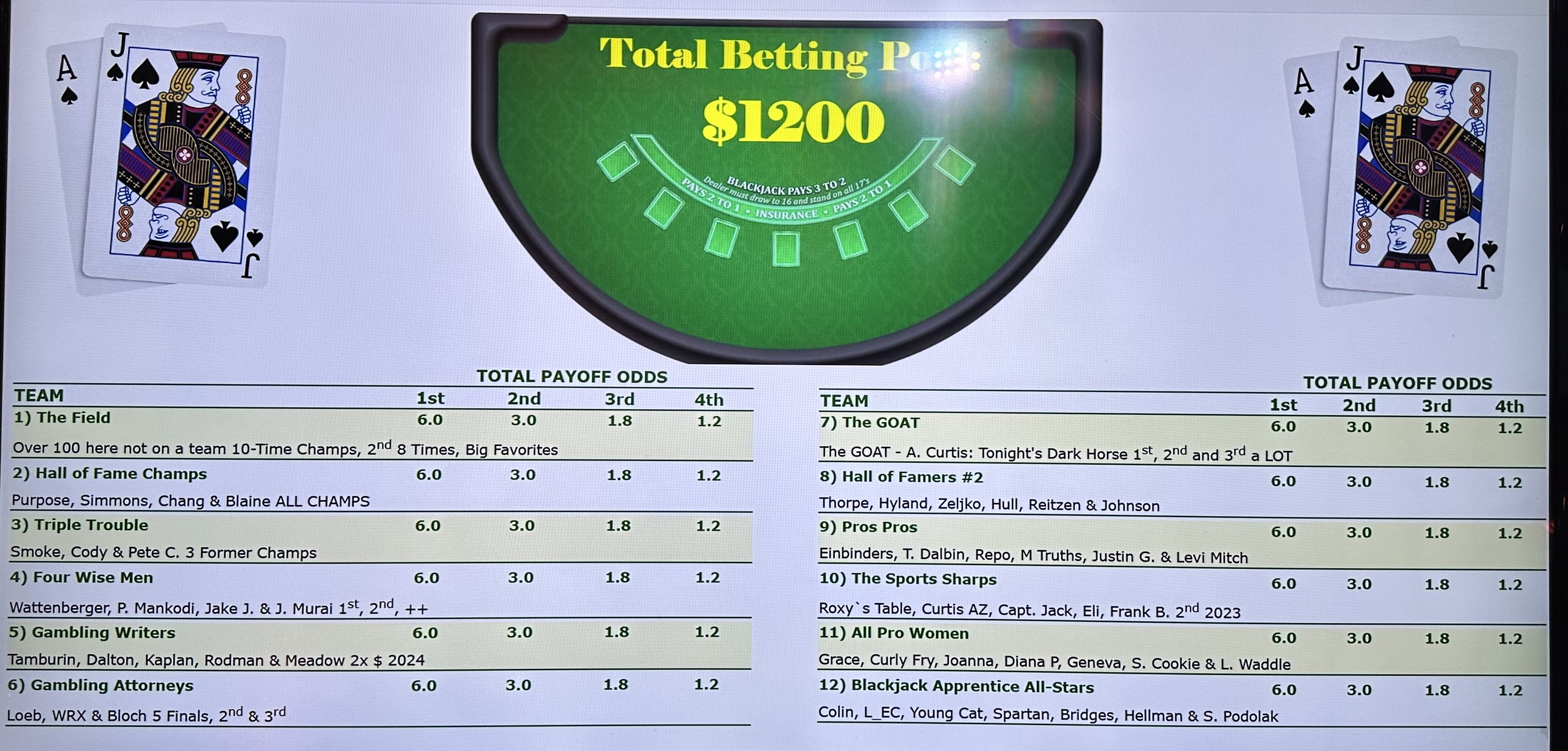
All attendees who arrived with a costume were given a “free” Calcutta betting card.  Mine ended up being worth $25 and I bet on Group 5: Gambling Writers, which I was part of.  I also placed a few other bets on some favorites including the “Field”.

Don Johnson makes his bets on who will win the Grosjean Cup.  Jesus and the Pope look on!
Don Johnson makes his bets on who will win the Grosjean Cup. Jesus and the Pope look on!
The 2025 Blackjack Ball Betting Pool Options

🎩 The Ceremony of Skill

As tradition dictates, the evening wasn’t just about revelry. The infamous skills competition tested attendees on everything from answering difficult questions, card counting and memorizing cards, with the coveted Grosjean Cup awarded to the evening’s top performer. Whispers of side bets and impromptu strategy debates filled the air, proving once again that the Blackjack Ball is as much about intellectual sparring as it is about celebration.

Max Rubin announcing the 2025 Blackjack Hall of Fame inductee!
Max Rubin announcing the 2025 Blackjack Hall of Fame inductee! Keep reading below.

The Fastest Card Counter on Earth

As Yancy and I arrived early at the event, we immediately got our names down for the card counting contest, which was structured in a single-elimination bracket arrangement.  Entries were limited to the first 56 players. This year’s contest was single-deck, 3 cards removed.  Most participants used the Hi-Lo count. You choose how you want to count.  Methods didn’t matter – only speed and accuracy did.  In the end, it was not surprising that Darryl Purpose won the contest – at 11.3 seconds.  He was always regarded as one the fastest card counters on Earth.  Magician turned card counter Steven Bridges came in second.4)

I Got Your Cards Right Here

Steven actually only had to count 2 cards less than Darryl.  Reason?  Before the event, and only if you were in costume, you got a free handicap card.  You could use this card at any time.  The card was worth a 0 to 12 card advantage.  In other words, if the card said 5, then 5 cards would be removed from the deck to make it neutral.  Darryl won the contest even though Steven had a 2 card advantage!  According to Max, if Steve had received a 4 or higher, he’d have won because the contest was so close.


Finalists Darryl Purpose and Steven Bridges battle it out for the fastest card counter competition
Finalists Darryl Purpose and Steven Bridges battle it out for the fastest card counter competition. Max Rubin and Ed Thorp look on.


Final card counting competition between Purpose and Bridges.
Yes, that is a baccarat table!  We really didn’t need a blackjack table. :-)


Dr. Timothy Fong:  UCLA Gambling Addiction Studies

On March 15, 2022, the Blackjack Hall of Fame became a 501c3 non-profit corporation which allows the Blackjack Ball to have a charitable purpose.  This year they presented UCLA’s Gambling Addiction Studies. 

Dr. Fong emphasized the pervasive nature of gambling in American society, noting its growing influence—particularly through the expansion of sports betting—and its dual role as both a social connector and a potential source of harm. While gambling can bring people together, he cautioned that 1–2% of the population may develop gambling addiction, a condition with serious consequences.

At UCLA, his team studies the biological, psychological, and social roots of gambling behavior and addiction, aiming to develop effective treatments. He proudly highlighted California’s 16-year commitment to providing free gambling addiction treatment, which has helped over 12,000 individuals.

However, he warned that continued progress depends on sustained funding. Contributions from the Blackjack Ball will directly support research into residential treatment, new medications, and other innovative approaches to recovery. He closed by expressing deep gratitude and reaffirming that every dollar donated will be put to meaningful use.

During Dr. Fong’s speech he commented: “I’ve learned more about gambling in (these) two hours than I probably did in the last 25 years of studying it and reading it from textbooks and papers.”  That’s definitely a testament to the Blackjack Ball attendees.

Dr. Timothy Fong: UCLA

The Grosjean Cup and Munchkin Award

It was never an easy task to win contests at the Blackjack Ball.  This year, the final contest was to steer a seen Joker playing 6-deck blackjack.  You needed to accurately estimate the cut (around one deck), play one to three hands, and possibly eat cards to get closer to the Joker.  In the end “The guy with the green hat“, also known as eevee, won the last contest and the Grosjean Cup.  He beat out the the legendary John Chang (former MIT Team manager and last year’s Grosjean Cup winner) who won the Munchkin Award.

Winner of the Grosjean Cup (eevee) with the legendary Don Johnson.

🏆 Hall of Fame Honors

The highlight of the night came when Colin Jones, founder of the Blackjack Apprenticeship and a driving force in modern card counting education, was inducted into the Blackjack Hall of Fame. His contributions to training the next generation of advantage players and promoting ethical play earned him a standing ovation. Jones joins an elite group of inductees whose names are etched into the lore of the game.

The 2025 Blackjack Ball Winners
From left to right: Ed Thorp, Colin Jones, Darryl Purpose, eevee, Matt and Max Rubin.

🕵️ A Night to Remember

Max Rubin and Richard Munchkin, the event’s charismatic hosts, once again curated an evening that balanced secrecy with spectacle. The Ruvo Center’s dim lighting and eerie décor added a theatrical flair to the proceedings, while the underlying camaraderie reminded everyone that blackjack (and advantage play in general) is more than a game—it’s a lifestyle, a discipline, and for many, a lifelong pursuit.

As the night wound down and masks came off, one thing remained clear: the Blackjack Ball continues to be the heartbeat of the advantage play community. And in 2025, it pulsed with spooky brilliance.

Steven Bridges, Yancy Howard, Colin Jones and Michael Dalton


28th Blackjack Ball 2025 Podcast

IMAGE CREDITS: Michael Dalton and Yancy Howard
OTHER LINKS TO THIS EVENT: The Blackjack Ball by Jeff Edelstein

BLOG MENU

Footnotes

Footnotes
↑1If I missed anyone, let me know.
↑2James GrosjeanJames Grosjean was one attendee who never took his face mask off — a Squid Game worker.
↑3Yancy's JacketYancy Howard is the pseudonym for Dick Buechler – a successful poker player and blackjack card counter originally from Salem, New Jersey.  He comments that he learned about advantage play in the United States Marines where he was a Gunnery Sergeant during the Vietnam war era.  A former professional Heliarc (TIG) Welder and instructor, he now enjoys traveling the world in his retirement.  Ed Thorp signing Yancy’s jacket!  Yancy joked that he wouldn’t take $10000 for this jacket as it was signed by dozens of the best advantage players in the world.
↑4

I Got Your Cards Right Here

Steven actually only had to count 2 cards less than Darryl.  Reason?  Before the event, and only if you were in costume, you got a free handicap card.  You could use this card at any time.  The card was worth a 0 to 12 card advantage.  In other words, if the card said 5, then 5 cards would be removed from the deck to make it neutral.  Darryl won the contest even though Steven had a 2 card advantage!  According to Max, if Steve had received a 4 or higher, he’d have won because the contest was so close.

Beyond Card Counting: How Advantage Players Find Their Edge in Crypto Casinos

By Balazs Pal.

The legends of blackjack are often remembered for a single skill. The MIT Blackjack Team became a pop-culture icon through their card-counting exploits, yet their real genius lay in organization, treating gambling as a disciplined business. Don Johnson’s $15 million triumph over Atlantic City wasn’t powered by counting at all, but by negotiation: he secured conditions like S17 rules, resplit aces, and most importantly, a 20% loss rebate. That single clause turned a negative-expectation game into one where the math tilted in his favor before he even placed a bet.

Stack of Bitcoin

For decades, advantage play has been the art of finding flaws in the system. Whether through hole-carding, shuffle tracking, or exploiting rebate structures, the goal was always the same: shift the odds. But today, as blackjack migrates from felt tables to digital interfaces, many seasoned players assume their edge has vanished. Continuous shuffle machines and PRNG-driven1)EDITOR NOTE: PRNG stands for Pseudorandom Number Generator – a computational process that generates sequences of numbers that appear random but are actually deterministic and reproducible once the initial seed value is known. online decks have erased the memory of the shoe. Card counting, in its traditional sense, is dead.

That assumption, however, misunderstands the nature of advantage play. The modern advantage player’s edge has not disappeared, it has migrated. The battleground has moved from the pit floor to the browser window, and the negotiation now takes place long before the first hand is dealt. In this new landscape, the edge lies not in the count but in the conditions: payout integrity, privacy policies, withdrawal terms, and bonus structures. Understanding and manipulating these digital rules is the new form of advantage play.

The Modern “Table Rules”: Protecting Your Bankroll in the Digital Pit

In the old days, the biggest threat to an advantage player’s bankroll was the pit boss. A sharp eye, a discreet nod, and a back-off could end a profitable night in an instant. Today, the same dynamic exists, only in code. The new pit boss is the casino’s Terms of Service, and the back-off comes as an unexpected account freeze, a KYC request mid-withdrawal, or a voided payout due to “suspicious activity.”

These are the new table rules of the digital age, and they are far more opaque than any printed placard listing S17 or DAS.

Ambush KYC: The Identity Trap

Many crypto casinos market themselves as “no-KYC” or “anonymous” to attract privacy-focused players. The promise is appealing: deposit, play, withdraw, all without surrendering personal data. But in practice, many of these claims conceal a trap. Players are often allowed to lose anonymously, but the moment they win, the rules change. The casino suddenly demands full verification: government ID, address proof, income documents, even source-of-funds declarations.

This is not legitimate compliance; it is selective enforcement, a way to protect the house when the cards fall in the player’s favor. The result is a perverse asymmetry, total transparency for the player, total opacity for the operator.

The VPN Grey Zone

VPN use adds another layer of risk. Many skilled players, especially those traveling or in restricted markets, rely on VPNs to protect their connections and personal data. Some casinos block VPNs outright, others permit them transparently, but the most dangerous ones live in the grey zone. They allow VPN use silently, until it becomes convenient to weaponize it against a winner. A buried clause like “Accounts using proxy servers may be voided” becomes an instant reason to confiscate funds.

This ambiguity introduces a new, unquantifiable threat: Platform Integrity Risk. Traditional “Risk of Ruin” (RoR) can be modeled mathematically based on variance and edge. But “Risk of Confiscation” is binary, 100% loss if triggered. An operator with vague or predatory policies can nullify even the most perfect strategy.

This is why due diligence in selecting a casino has become the digital equivalent of scouting tables for S17 and late surrender. The modern advantage player must investigate licensing, payout consistency, and policy enforcement before ever making a deposit.

As one analysis-focused site puts it, this process is pre-play advantage play. It is a different kind of counting, counting red flags, not cards. To assist in this kind of analysis, https://VPNCasinos.io has become one of the few resources systematically grading casinos based on real player experience, payout integrity, VPN tolerance, and withdrawal reliability. Its evaluations of instant withdrawal casinos go beyond speed, assessing whether an operator’s KYC and AML enforcement respects players or merely entraps them. For the modern advantage player, these digital rules are just as crucial as any blackjack rule variation ever was.

The New “Comp”: Bonuses as Negotiated Edge

In the golden age of blackjack, comps and rebates were the professional’s hidden weapon. Don Johnson’s 20% rebate was a negotiated comp so powerful it turned an even game into a profitable enterprise. In online casinos, that same mechanism exists under a new name: the casino bonus.

On the surface, bonuses are presented as free money. In practice, they function as the most complex and misunderstood variable in the entire gambling ecosystem. Like a rebate or coupon, a well-structured bonus can theoretically offer a temporary edge, but only if the terms align mathematically.

The key lies in calculating Expected Value (EV):

EV = (Bonus Amount) − (Wagering Requirement × House Edge)

If that result is positive, the offer might be worth pursuing. But the reality is that most bonuses are negative EV once all hidden restrictions are factored in.

Let’s illustrate with a typical example:

  • Bonus: $100
  • Wagering Requirement: 35x bonus
  • Game: Blackjack (House Edge 0.5%)
  • Game Contribution: 10%

At first glance, the player needs to wager $3,500 to clear the bonus. But since blackjack contributes only 10% toward the requirement, the effective rollover balloons to $35,000. The expected loss is $35,000 × 0.005 = $175. The $100 bonus now has a -$75 EV.

This structure isn’t random, it’s intentional. Bonuses are engineered to push players toward high-edge games like slots (where game contribution is 100% and house edge can exceed 4%). In other words, they are designed to redirect skill-based players into negative EV territory.

Because of the overwhelming complexity of these offers, varying rollover structures, game exclusions, max cashout limits, and expiry times, manual analysis has become nearly impossible at scale. This has given rise to a new category of data-driven tools that apply algorithmic analysis to bonus terms, effectively automating the EV audit process.

Platforms like https://freecryptobonus.com/ have built AI-powered grading systems that evaluate bonuses across metrics like wagering difficulty, eligible games, and hidden restrictions. They score offers based on expected value, surfacing the few that genuinely improve a player’s long-term EV. For serious players who treat bankrolls like trading portfolios, this is the equivalent of screening the market for undervalued assets.

In that sense, analyzing a casino bonus has become the online analog of negotiating your table conditions in the pit. The numbers matter, and so does the fine print.

Using a Laptop to Gamble Online

Adapting the Advantage Player’s Mindset

The advantage player’s mindset has always been timeless: study the system, find the flaws, exploit the edge. What’s changed is the domain.

The physical act of counting cards may be obsolete in an environment where decks are reshuffled by algorithm, but the strategic discipline behind it, the analytical mindset, the risk management, the refusal to accept the posted rules at face value, has never been more important.

The hierarchy of player decisions has simply shifted:

  1. Platform Selection:
    Choosing a trustworthy casino is now the single most important edge-defining decision. A player can execute flawless basic strategy, but if the operator hides behind ambiguous payout terms or enforces “Ambush KYC,” the EV is irrelevant.

  2. Bonus Analysis:
    Bonuses function as the new rebate negotiations. Proper EV evaluation determines whether they offer an actual edge or serve as sophisticated loss traps.

  3. Execution at the Table:
    Perfect basic strategy remains a baseline skill, but its impact is now secondary. Without fairness and transparency at the platform level, no strategy can overcome an operator’s asymmetric control.

In this framework, advantage play begins before the first hand is ever dealt. The most successful modern players don’t just memorize index plays, they dissect policy documents, test withdrawal speed, and verify payout integrity. The game has expanded beyond the cards.

Conclusion: The Edge Never Died, It Moved

The evolution from pit floors to crypto casinos has not ended advantage play; it has simply redefined its terrain. The real game is no longer about beating the shoe, it’s about beating the system that defines it.

The modern advantage player negotiates edges through policy literacy, privacy control, and EV analysis rather than through camouflage and team signals. The math remains the same, only the battlefield has changed.

In 2025, the smartest move in blackjack might be the one made before you even log in: choosing a platform whose rules are built for fairness, not entrapment. The new advantage is not hidden in the deck, it’s hidden in the fine print. And for those still chasing the timeless thrill of playing with an edge, that’s where the real count begins.

IMAGE CREDITS: AI Generated

BLOG MENU

Footnotes

Footnotes
↑1EDITOR NOTE: PRNG stands for Pseudorandom Number Generator – a computational process that generates sequences of numbers that appear random but are actually deterministic and reproducible once the initial seed value is known.

KO with Table of Critical Running Counts (Update)

KnockOut BlackjackBy Blackjack Rebel.

In my last article, High-Low (HL) count with 7m9c, I had suggested that Knock-Out (KO) is a better count for the shoe game than HL and I said I would not cover why in that article.  So I am writing this article to explain why the KO is a better primary count for the shoe game than HL is. For the two deck game still use HL as the primary count but for the shoe game, KO is much better.1)EDITOR NOTE: This article was originally published on Oct 22, 2024.  It has been republished here to simplify the presentation and make it easier to understand and use.  The author is hopeful this new KO with TCRC article will draw interest and appreciates any comments or feedback.

This article will cover just the primary KO count along with a Table of Critical Running Counts (TCRC) for eight and six decks as an alternative to the High-Low (HL) for a shoe game. Some symbols used in this article are tc (or simply “t”) = true count, dp = decks played, dr = decks remaining, n = number of decks and crc = critical running count. 

The KO is the HL with the sevens counted as +1 instead of 0 as in the HL. The HL is balanced at zero and so counting the sevens as +1 creates the unbalanced KO with an unbalance of four per deck. Similar to the balanced HL, start the KO at zero at the beginning of each shoe.

A major problem with switching from HL to KO was how to get accurate true counts with the unbalanced KO. This is solved with the Table of Critical Running Counts (TCRC). Use the following TCRC to get the KO true count from the KO running counts and decks played for playing strategy variations and also determine how many units to bet based using the KO running count and decks played. There is no need to do any true count calculations. Just memorized the TCRC and the betting table included in this article for the six and eight deck games which has a simple pattern. For example for a KO true count of one the crc increases by three for each deck played and for a KO true count of six the crc decreases by 2 for each deck played and they all converge to the pivot of 24 for six decks and 32 for eight decks as decks are played. The formula for six decks is crc(t) = 24 + (t – 4)*dr and for eight decks is crc(t) = 32 + (t – 4)*dr. If t = 0 then crc(t) = 4*n + (t – 4)*dr gives crc(0) = 4*n – 4*dr = 4*(n – dr) = 4*dp.

The KO indices for strategy variations are basically the HL indices. Three notable exceptions (all with a dealer up card of Ten) where the KO index is less than the HL index (see KO Risk Averse Indices chart) are: stand on hard 14 v T if KO ≥ crc(7), surrender hard 14 v T if KO ≥ crc(2) and surrender hard 13 v T if KO ≥ crc(6).

In addition to the ease of use of the KO count system where true counts can simply be looked up in a TCRC (instead of a true count calculation that is required with the HL), the KO true count at true counts of three or more where large bets are made and accuracy in true count calculations for betting and playing strategy variations is very important, are more accurate than the corresponding HL true counts.

HL has a pivot of a true count of zero and KO has a pivot of a true count of four. At a true count of six, for example, HL is six true count points away from its pivot and KO is two true count points away from its pivot and so KO true count of six using TCRC is three times more accurate than a HL true count calculation of six. In this situation, if HL true count where to obtain the same accuracy as the KO true count, decks would need to be estimated to the nearest third of a deck and HL true count calculations would need to be accurately divided by decks to the nearest third of a deck.

Consider the following example which demonstrates the accuracy of KO true count estimates as compared to HL true count estimates when the true count is close to the KO pivot of a true count of four. In the case of splitting T,T v 6 the expected value index is five but the risk averse index is six. So for six decks and estimated dr = 3 then using the risk averse index, split T,T v 6 if HL ≥ 6*dr = 6*3 = 18 and split T,T v 6 if KO ≥ crc(6) = 24 + 2*dr = 24 + 2*3 = 30. Now suppose the actual decks remaining were four and not three.

  • Splitting T,T v 6 with HL = 18 is splitting T,T v 6 not a HL true count of six but at a HL true count of HL / actual decks remaining = 18 / 4 = 4.5 so T,T v 6 is actually being split below T,T v 6 expected value index of five even though the risk averse index of six was used.
     
  • Splitting T,T v 6 with KO = 30 is splitting T,T v 6 not at a KO true count of six but at a KO true count, using tc(KO) = 4 + (KO – 4*n) / dr, of KO = 4 + (30 – 4*6) / 4 = 4 + 6 / 4 = 5.5. Thus even though the estimated decks remaining was off by a full deck to the actual decks remaining, the KO true count was at 5.5 and so was still above the KO expected value index of five for splitting T,T v 6.

Accuracy of tc(KO) to tc(HL) at tc = 3, 4, 5, 6 for n = 6 decks:

  1. KO = crc(3) = 24 – dr    three times as accurate as HL = 3*dr
     
  2. KO = crc(4) = 24    exact as compared to HL = 4*dr
     
  3. KO = crc(5) = 24 + dr   five times as accurate as HL = 5*dr
     
  4. KO = crc(6) = 24 + 2*dr three times as accurate as HL = 6*dr

Thus KO is superior to HL for the shoe game because:

  1. Power: KO is the theoretically most powerful level one count.
     
  2. Accuracy: KO is more accurate than the HL at true counts of three or more. KO estimation to the nearest deck is sufficient.
     
  3. Ease of use: KO with its TCRC or the simple formula crc(t) = 4*n + (t – 4)*dr is easier to use than HL true count calculations.

IMAGE CREDIT: Microsoft AI Copilot

INTRODUCTORY COMMENTS
EXAMPLES, CHARTS AND EXHIBITS
SCORE COMPARISON
TKO SIMULATIONS

BLOG MENU

Footnotes

Footnotes
↑1EDITOR NOTE: This article was originally published on Oct 22, 2024.  It has been republished here to simplify the presentation and make it easier to understand and use.  The author is hopeful this new KO with TCRC article will draw interest and appreciates any comments or feedback.

When Blackjack Meets the Data-Driven Mind

By Kami Turky.

Blackjack has always balanced skill, luck, and quick intuition. The thrill comes from trying to outsmart both the dealer and the odds.  Today, though, there’s a shift happening at the tables. With powerful analytics and endless streams of data now available, more players are turning to statistics and technology instead of hunches.

This new approach changes everything—from how strategies are tested to how wins and losses are tracked. In this article, we’ll look at how a data-driven mindset is transforming blackjack into a game where analysis rivals instinct.

People playing blackjack

The rise of data-driven betting: lessons from Stake Hunters

It’s no longer enough to rely on luck or gut instinct when placing bets. Data is changing the entire game, not just in blackjack but across all forms of sports betting.

Platforms like Stake Hunters are at the forefront of this shift. They bring transparency and accountability by publishing verified records for each tipster—win rates, profit margins, and yield percentages included. This approach lets users make decisions grounded in real numbers, not rumors or bravado.

In practice, that means you can easily compare tipsters’ long-term results before risking your money. The ability to filter by sport, timeframe, or even specific bet types removes much of the guesswork that’s plagued bettors for decades.  What impressed me most is how data moves betting out of the shadows and into a more scientific space. You’re no longer flying blind—you’re using past performance as a guide and adjusting strategies based on what actually works.

This trend is empowering both newcomers and veterans. Novices learn faster with clear metrics, while experienced bettors refine their edge by tracking patterns over thousands of bets. The takeaway is simple: in the age of analytics, those who embrace data stand a far better chance than those who ignore it.

Card counting and beyond: the evolution of blackjack analytics

Blackjack has never stood still. The game’s reputation for being “beatable” started with card counting, but today’s edge-seekers are far more data-driven than their predecessors.

Modern blackjack strategy goes well past mental arithmetic or memorized charts. Players now rely on advanced simulation software, probabilistic modeling, and even artificial intelligence to explore thousands of hands and uncover strategies that would be impossible to spot with the naked eye.  As technology pushes forward, the definition of an advantage player is changing. Success at the tables depends less on raw memory or nerve, and more on a player’s ability to interpret patterns, run simulations, and apply analytics in real time.

Simulation software and probabilistic modeling

If you think crunching numbers with pen and paper is enough for serious blackjack analysis in 2025, think again. Modern players run millions of simulated hands using powerful software to test every possible scenario—tweaking strategies based on rules variations, deck composition, and betting patterns.

A recent feature by MathWorks (2023) illustrates how simulation software like MATLAB can model millions of blackjack hands, allowing players to optimize core strategies, assess risk, and adapt to different rule variations far more efficiently than manual analysis. Running these models isn’t just about confirming basic strategy—it’s about finding subtle adjustments that squeeze out a fractional edge where it matters most.

Machine learning: the next frontier

The biggest leap for advantage players is happening right now with machine learning. Artificial intelligence tools can identify complex dealer tendencies or shuffle patterns that humans might overlook. This isn’t science fiction—it’s already happening at tech-savvy blackjack tables worldwide.

A 2023 Medium article demonstrates how neural networks and machine learning techniques can discover hidden patterns in dealer behavior and adapt player strategy in real time, pointing toward an AI-driven future for blackjack analytics. The potential? Personalized recommendations mid-session—helping players pivot instantly as conditions change. In a world where milliseconds matter, this could redefine what it means to have an “edge.”

Psychology, bias, and the human factor in data-driven play

You can have all the stats and simulations in the world, but blackjack still happens in a human brain.  Even the most analytical players face emotion and bias that threaten to steer them off course.  The challenge is balancing hard numbers with psychology, risk tolerance, and the thrill of unpredictability that keeps players coming back to the table.

Cognitive biases: friend or foe?

I’ve seen sharp players run into trouble when their thinking gets clouded by classic cognitive traps.  The gambler’s fallacy—believing a win is “due” after a streak of losses—or overconfidence after a lucky run both lead to bad bets.

Data-driven bettors fight these urges by relying on statistical models instead of gut feelings. Reviewing hand histories or using tracking apps makes it easier to spot when bias might be influencing decisions.

The bottom line: A rational approach helps keep emotions in check, but everyone slips sometimes. Knowing your weak spots is step one to beating them.

Emotional discipline in high-stakes play

Holding steady when you’re up—or deep in a downswing—is where real skill comes in. No spreadsheet can quiet adrenaline or frustration at the table.  Veteran players lean on techniques like deep breathing, walking away after big hands, or sticking to pre-set betting limits no matter how they feel in the moment.

Emotion Regulation in Gambling, a 2023 study on ResearchGate, highlights how emotional regulation impacts cravings and self-control for gamblers. The research shows that managing emotions isn’t just helpful—it’s essential for making rational decisions under pressure.  The best advantage comes from staying calm and letting data—not impulse—lead your game when it matters most.

Responsible gambling in the age of analytics

Access to real-time data and analytics has changed the way people approach gambling, including blackjack.  This shift brings not just new strategies but also a sense of responsibility that wasn’t always possible before.

By leveraging analytics, players can set clear limits, spot unhealthy trends, and make more conscious decisions at the table.  The best tools now go beyond tracking wins and losses—they encourage self-awareness and sustainable habits by making key information visible and actionable.

Using data to set limits and track behavior

One of the most valuable developments for responsible gamblers is the ability to track every aspect of play with precision.  Apps and betting platforms now offer dashboards that display total wagers, time spent playing, win-loss records, and even patterns in betting size or frequency.

This visibility helps players recognize when their habits might be drifting into risky territory—sometimes before they notice it themselves.  It’s a major shift from guessing or relying on memory. Now you can set personal spending caps, receive automated alerts for unusual activity, or take breaks based on real usage data instead of just gut feelings.

The role of transparency and community

Verified reporting and open communities have become key defenses against problem gambling in today’s data-rich environment.  Platforms that publish honest results—whether from professional tipsters or casual players—give everyone a clearer picture of what’s really possible (and what’s not) over time.  This collective approach makes it easier to talk openly about losses as well as wins, lowering stigma and helping people spot potential issues early on.

Responsible Gambling Program Data from Oregon Lottery (2023) shows how analytics-driven monitoring empowers individuals with real-time insights. Transparent reporting encourages healthy habits and gives users direct access to resources when needed—a model that’s already making a measurable difference in how communities support responsible play.

Blackjack in the hands of the data-driven player

Blackjack has come a long way from relying on gut feelings and lucky streaks.  Today, players armed with analytics and disciplined strategy can approach each hand with a level of confidence that old-school intuition rarely provided.

Whether you’re running simulations to fine-tune your tactics or using tracking tools to manage your play, embracing data isn’t just about chasing an edge—it’s about enjoying the game with more insight and control.  In a world where information is power, blackjack belongs to those who think strategically and stay curious about the numbers behind every deal.

IMAGE CREDIT: Pexels.com

BLOG MENU

Smart Tech at the Blackjack Table: How Players Are Using Digital Tools

By Katerina.

After slots, blackjack tables are some of the most popular games in casinos. Blackjack is also one of the most popular online casino games. The game’s rules are easy to learn, and a basic betting strategy can help quickly improve results.

Whether a player is looking to learn the basic rules or improve their performance, there is a great selection of digital tools that can help improve all areas of blackjack gaming.

Blackjack

Online Blackjack

Gambling laws differ from jurisdiction to jurisdiction. And, even in individual jurisdictions, laws can differ according to the game played. In Florida, for example, blackjack and other casino games can be legally played at tribal casinos, but iGaming has not yet been regulated in the Sunshine State. 

However, according to esportsinsider.com, online casinos are accessible in the state, and gambling expert Viola D’Elia points to the popularity of blackjack at online casinos as being notable.

There are several reasons for the continued popularity of blackjack. The basic rules are simple to learn, and a tight blackjack strategy, which minimizes losses and improves the chances of hitting winning streaks, is also simple to pick up.

Games are short, and there isn’t as much data produced in a single game of blackjack as in other games like poker. This makes it possible for players to study form, optimize gameplay, and reap the benefits.

This, coupled with improvement in technology and greater access to personalized player data, means players are in stronger positions than ever before.

Online Apps

One of the most significant ways technology has changed blackjack is through its offering at online casinos. Players do not need to head to physical casinos or card rooms to enjoy a game. They can log onto a website or app and start playing. With the advent of 5G mobile Internet, which is very beneficial to mobile gamers, and improvements in mobile technology, this means that blackjack lovers can play anywhere, anytime.

Cryptocurrency Payments

Another improvement that has further facilitated the shift to online play is cryptocurrency. Cryptocurrency payments can be sent across borders instantly and at a fraction of the cost of traditional payments like bank transfers and credit cards. Cryptocurrency is also decentralized and offers greater privacy and potentially higher levels of payment security.

Blockchain Games

Cryptocurrency is developed on blockchain networks. These networks are digital ledgers that can be used to store any transactions or data. Although cryptocurrency is one of the most common uses of these networks, they can also be used to establish smart contracts and for the creation of decentralized apps.

Some online casinos and online casino games are developed on blockchain, which means that every individual bet and game is stored on the blockchain. For players who are looking to analyze their past performance and use this data to improve their future performance, such immutable records can be invaluable. Players just need access to blockchain explorer software, which is readily and freely available.

Strategy Guides

One of the reasons for blackjack’s continued popularity, even in the face of rising demand for games like crash games and aviator games, is the possible deployment of a basic blackjack betting strategy. The game is simple and quick, and there aren’t too many complexities. This makes it possible for players to learn strategy, with basic strategies readily available online.

It is also possible to use blackjack apps, including those that use play money rather than real money, to hone a strategy. Players can be well prepared when they start playing for real cash.

AI Strategy Optimization

A basic strategy can improve your chances of winning hands of blackjack while minimizing losses. This effectively requires a player to learns when to stand, hit, double down, or buy insurance, according to the hands they have compared to the card the dealer is showing. However, there are some variances in games.

While some games of blackjack have the dealer stand on soft 17, others do not. While a rare few games use single decks, others use multiple decks. Some offer insurance, some don’t. All of these variances mean that an optimal strategy can change from one game variant to the next.

AI strategy optimization uses artificial intelligence to identify the best strategy for a particular game and taking into account personal factors like a player’s aversion or desire for risk. AI can also determine a player’s weak spots and give clear guidance on how to improve. Essentially, AI can be used as a strategy teacher for regular blackjack players.

Manual Tracking

You don’t have to have complicated software to track blackjack hand data or game results, at least not when playing online. Most online casinos offer game history. This not only shows how much money a player has won or lost over time, but it also breaks down performance to show individual game results. This can include hand data, including the player’s cards and the dealer’s cards, as well as how the player bet and the result.

Even without specialist software, players can track this information in a spreadsheet, recording critical data and using the information to formulate their own strategy or to identify areas for optimization.

Hand Tracking Apps

For those who do want to take their game to the next level, there is specialist software that can assist. Hand tracking apps can record game results from online casinos. Whereas using a spreadsheet, the player then has to manipulate and work with the data, specialist apps know what to look for and how to formulate the data so it is beneficial to the blackjack player.

It can highlight whether a player is too aggressive or passive, and how to improve results I the hope of turning profits at the tables.

Wearable Tech

Wearable technology can prove beneficial to players, especially in the analysis of gameplay and in complex strategies like card counting. However, it should be noted that card counting is generally frowned upon by casinos. They may use strategies to disrupt players from doing it manually, such as having dealers talk to players they believe are counting cards. And, if a casino suspects you’re using wearable technology or other devices to assist in card counting, they may have you removed from the casino.

However, the technology does exist for items like smart glasses or other smart devices to record gameplay, determine the cards that have been played, and present discreet signals to indicate the likelihood of turning certain cards.

VR Games

Virtual reality is still an emerging technology, and while there aren’t yet too many online casinos in the metaverse, they do exist. In the future, players will likely be able to bet on blackjack at virtual casinos just as easily as they can using mobile iGaming apps.

In the meantime, it is certainly possible to find blackjack and other card apps that allow players to play for fun. This can be a great opportunity to practice card counting skills and other strategies while in a realistic gaming environment.

IMAGE CREDIT: Unsplash.com

ABOUT THE AUTHOR: Navigating the world of technology can be challenging, but Katerina loves riding into the eye of the storm. Her biggest strength is her knack for translating complex concepts into accessible content. Balancing a thriving career in content creation on entrepreneurship and technology, she finds solace in her cozy home with a loving husband and an energetic dog.

BLOG MENU